|
|
|
|
| Organize
Today |
Learn
more about organizing your workplace!
Click Here |
|
|
|
|
|
|
|
|
|
|
Welcome
|
|
|
You are not
currently logged in.
|
|
|
|
|
The Union for Advocates
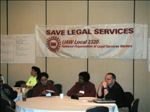
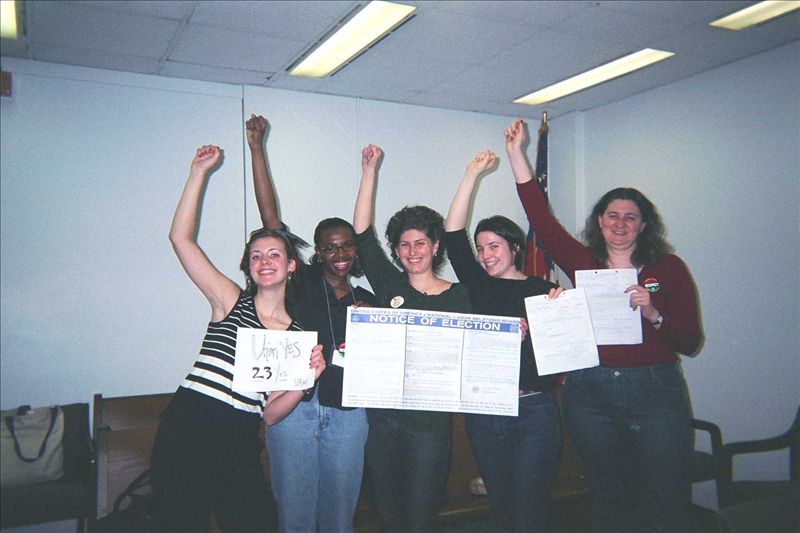
The National Organization of Legal Services Workers (NOLSW), UAW Local 2320, AFL-CIO is the union representing the majority of those who work in federally-funded legal services programs across the USA. We also represent workers in other types of law offices and in various human services programs. We are proud to be an amalgamated local union of the United Auto Workers union, through whom we join with our brothers and sisters in the American labor movement to seek economic and social justice for working people everywhere. We are also proud of our record in the leadership of the struggle to preserve and strengthen legal services for the poor. We welcome all workers in legal and human services to join our union in this fight. If you want to organize a union at your workplace, receive information about our union, or want to work with us in the struggle to save legal services for the poor, we invite you to contact us. 
|
|
|
|
Obama Proposes to Lift Restrictions
Posted
On: May 07, 2009 (16:36:14)
The details of President Obama's FY 2010 Budget have been released and there is very good news for Legal Services. In addition to his suggested $435 million for LSC, an 11.5% increase over FY 2009, President Obama is proposing to remove all of the 1996 appropriation restrictions on the use of non-LSC funds. In addition, the President has called for the elimination of two key restrictions with respect to LSC funds -- the ban on class action law suits and the prohibition against collecting attorneys fees. Click on the link below to see the appropriations for LSC in President Obama's FY 2010 budget.
Download:
Pres Obama FY2010 request for LSC.pdf
|
|
Lifting Restrictions on Legal Services
Updated
On: May 05, 2009 (19:02:00)
Supporters of lifting the restrctions on legal aid programs funded by the Legal Services Corporation (LSC) have signed on to a letter urging the Chairs and Ranking members of the Senate and House committees respsonsible for legal services issues to lift the restricts on LSC. Since 1996, congrerss has placed LSC under restrictions that have severly hampered legal services ability to assist low-income clients. Among the restrictions imposed on LSC was not being able to seek attorneys' fees and prohibition on class action suits. NOLSW/UAW Local 2320 is a signer of the letter. To read the letter, please click on the link below.
Download:
Legal Services Sign-on Letter.pdf
|
|
|
|
|
|
|
|
|
|
|
|
AFL-CIO News
Winning Together�NEA and the AFL-CIO
Congratulations to the seven lucky National Education Association (NEA) members who today won top prizes in the AFL-CIO Winning Together Contest by displaying their knowledge of the power of union solidarity.
The contest was sponsored by the federation’s Unity Partnerships project and was open to NEA members and staff attending the NEA Representative Assembly Expo in San Diego this week.
To enter the contest, participants answered a question about the combined voting strength of NEA and AFL-CIO active and retired households in their home states. Those who answered correctly were eligible for the grand prize and two second prizes. Everyone who submitted an answer was eligible for one of three third prizes.
In today’s drawing, Carol Sampsel�of State College, Pa., won the grand prize of a $1,000 Costco gift certificate. Sampsel�says:
[I] Just got a new place to live so this will come in handy!
The second prize winners, who each receive an AT&T BlackBerry Curve 8320 cell phone, are:�
- Angela Gonzalez of�Miami, Fla.
- Nancy Gentis of Las Vegas
- Claudia Bock of�Newark, Del.
And the three winners of the third prize�an AT&T Samsung SGH-a737 cell phone�are:�
- Lynette Wright of�Elburn, Ill.
- Mary Mayof Nashville, Tenn.
- Amy Peel of Reno, Nev.
Unity Partnerships is a groundbreaking agreement between the national AFL-CIO and the NEA that allows local NEA associations to affiliate directly with the AFL-CIO.� The program is supported by the AFT, a longtime AFL-CIO affiliate.
| Maine GOP State Legislator Supports Employee Free Choice Act, and Other Highlights from Around the Country
Guess who’s joining the campaign for the Employee Free Choice Act in Maine?
It’s state Rep. Jim Campbell, a Republican who is defying the expectations of pundits and corporate shills by supporting workers’ freedom to form unions and bargain. He has appeared at public events around the state and written in local news outlets to show his support for the Employee Free Choice Act.�
Here’s what Campbell says about the need to pass the Employee Free Choice Act and its importance to rebuilding the economy:�
Common-sense solutions should be used to create good jobs that can support a family and put money back into our economy. Historically, no institution has been as effective at improving the quality of life for working families as membership in a union. Union members earn better wages, have better health care coverage and can count on a more secure retirement than nonunion workers.
 |
� |
| � |
Arkansas union members rally for Employee Free Choice. |
� |
|
� |
| � |
While Campbell joins the grassroots campaign in Maine, union members and allies across the country have been busy during this week’s congressional recess. Here are some highlights from the fight for Employee Free Choice:�
- In Minnesota this week, Sen. �Al Franken, who supports the Employee Free Choice Act,�thanked his “brothers and sisters” in the union movement who worked hard during his campaign. He said his own union membership helped him to get health care. Congratulations again to Minnesota’s newest pro-worker senator, who will be a valuable voice in Washington.
- In Louisiana, union members, faith leaders and other supporters of the freedom to form unions are kicking off a petition drive and a new round of visits to the offices of their U.S. senators.
- Members of the Plumbers and Pipefitters (UA) in Virginia are holding working lunches to write letters to their senators supporting Employee Free Choice. Union members�also are holding working lunches in Wisconsin.
- In Arkansas, union members and allies are getting ready for a major push on the Employee Free Choice Act over the next week that will include rallies and town hall meetings.� They continue to deliver thousands of handwritten letters to their senators.
- In Colorado, union members are remembering the past by honoring the miners of Ludlow and looking to the future by gathering local support for the Employee Free Choice Act from workers and small business leaders.
| June Job Loss Hit Most Industries
 |
� |
| � |
� |
The 437,000 jobs lost in June were spread throughout most U.S. industries, according to the Labor Department’s Bureau of Labor Statistics (BLS).�
Manufacturing employment fell by 136,000 in June, while employment in construction decreased by 79,000.� Job losses in professional and business services shot up in June, with the industry shedding 118,000 jobs. Retail trade employment was down by 21,000 in June.
Education and health care employment increased by 34,000, and employment in government dropped by 52,000 in June.
The overall unemployment rate increased to 9.5 percent in June, putting it at a 26-year high.
AFL-CIO President John Sweeney said today’s jobs data show that creating jobs is the key to a full economic recovery.
Congress and the Obama administration need to continue to remain focused on stimulus efforts to end the recession. Additionally, this is not just a problem in the United States, but at this stage, job loss is the vortex of the global economic crisis.� To address this problem we believe that all governments should focus an extra 1 percent of GDP [gross domestic product] for stimulus focused on job creation.�
The rate of job loss has been slowing, but even if that trend continues and the recession ends this year, the nation likely will confront a massive employment deficit of 10 million jobs and a long period of slow wage growth, according to the Economic Policy Institute (EPI).�
In the early 1990s, it took 15 months from the official end of the recession before the unemployment rate stopped rising�and 19 months after the end of the recession in the early 1980s. But it’s not sufficient for the unemployment rate to fall to turn around the economy. The number of new jobs created must keep up with population growth�that means 127,000 news jobs must be created a month, EPI says.�
In a June 30 conference call, EPI President Lawrence Mishel noted another trend that is slowing the recovery: stagnant wages. The BLS reported that wages continued to drop in June, with average weekly pay for nonmanagerial workers falling to $609.37, from $609.51.�
If the current recession ends with a return to the way things were before it began, Mishel says, working families won’t have much to celebrate.� “Even before the perfect storm hit Wall Street, housing, and the banks, the economy was already broken for workers.”�
That means our challenge won’t end when the recession does. Unless we fix our broken economy so that it will start to provide fair value for work again, working families will keep losing ground.
| Unemployment Rate Hits 9.5 Percent�a 26-Year High
The U.S. unemployment rate increased to 9.5 percent in June, a 26-year high, and up slightly from 9.4 percent in May. Some 467,000 jobs were lost in June, according to data released today by the Department of Labor.�
The number of long-term unemployed (those jobless for 27 weeks or more) increased by 433,000 over the month to 4.4 million. That is an increase of more than 100,000 over the job loss in May.
This is the 18th straight month of job loss, with 6.5 million jobs gone since the start of the recession in December 2007.
There are now 14.7 million jobless U.S. workers, a number that doesn’t reflect the severity of the problem. When the underemployed and those who want jobs but have given up looking are counted, the broader U.S. unemployment rate stands at 16.8 percent�more than�25 million people who need jobs or full-time work but cannot find it.�
The recession has wiped out the entire growth in jobs over the past nine years�the economy currently has fewer jobs than it had in May 2000, according to the Economic Policy Institute (EPI). The workforce, however, has grown by 12.5 million workers since then.��
Says EPI economist Heidi Shierholz:
This is the only recession since the Great Depression to wipe out all jobs growth from the previous business cycle, a devastating benchmark for the workers of this country and a testament to both the enormity of the current crisis and to the extreme weakness of jobs growth from 2000-2007.�
| Ayers: Employee Free Choice Act a �Win-Win� for Workers, Business
 |
� |
| � |
� |
Cutting through the myths and explaining the importance of workers’ freedom to form unions and bargain,�Mark Ayers, president of the AFL-CIO Building and Construction Trades Department (BCTD), makes the case for the Employee Free Choice Act in the upcoming issue of The Voice, the magazine of the Construction Users Roundtable (CURT).�
In an op-ed aimed at leaders in the construction industry, Ayers says much of the controversy around the legislation is based on “outlandish claims” by opponents who hope to keep workers from bargaining for a better life. Indeed, Ayers says, the freedom of workers to form unions and bargain is a tool to strengthen the economy.�
Ayers says that when it comes to wages, health care benefits and training of workers, unions help level the playing field and improve economic performance among employers:�
The Employee Free Choice Act is a win-win for America and American businesses. Unions are an essential part of a strong democracy, and they play a crucial role in our public and community life. Unions also make workplaces safer and more productive, and they work to raise professional standards.
Despite a disinformation campaign by big corporations, Ayers says, many business owners and entrepreneurs across the country support of the Employee Free Choice Act, knowing that workers with economic security and purchasing power will help rebuild the economy:�
We applaud the tens of thousands of responsible employers from our industry who have gone on record in support of the Employee Free Choice Act. They understand the value of widespread, shared prosperity in creating sustained economic growth in America. To them, the passage of the Employee Free Choice Act would be a welcome occasion.
Read the whole thing here.
| Hang Up and Fly�Tell Senate to Back In-Flight Cell Phone Ban
 |
� |
| � |
� |
If you get a chance, take a minute and do your part for airline safety and passenger sanity. The Flight Attendants-CWA (AFA-CWA) ) is urging the U.S. Senate to maintain the ban on in-flight cell phone use. Click here to send your senators a message.
The ban was included in the House-passed version of the Federal Aviation Administration reauthorization bill (H.R. 915) in May. The Senate is expected to act this summer. The union says:
“Cell phone usage in the cabin would create a new security risk, compromise flight attendants job of safely executing an emergency evacuation, and ability to maintain order within the cabin amongst cabin noise and tension.”
From the passengers’ viewpoint, don’t forget the possible nightmare of a middle seat, cross-country flight stuck next to a serial yakker. In an interview on the travel blog GADLING, Rep. Jerry Costello (D-Ill.) says the cell phone ban goes beyond just eliminating the annoyance factor.
Everyone has experienced poor cell phone etiquette and how annoying it can be. Our bill will make sure the current ban on in-flight cell phone use is not lifted. Beyond the annoyance factor, this is a safety issue. Flight attendants already have to deal with people that will not hang up their phones, and physical altercations between passengers are not unheard of. Also, in-flight cell phone use is not conducive to providing safety instructions and other important announcements.
Click here to send a message to your senators urging them to maintain the in-flight cell phone ban.
| Rural Economies Need Employee Free Choice

In a great new op-ed in Minnesota’s Bemidji Pioneer, Richard Levins, a professor emeritus of applied economics at the University of Minnesota, says the Employee Free Choice Act gives workers in rural economies the ability to bargain for a better life and restore the economy in their communities.�
He says the race to the bottom in wages isn’t working anymore for our economy and calls the Employee Free Choice Act a “much-needed stimulus” for rural economies.�
Levins writes:�
Corporate opponents of the act know that when workers do the same job for less, the rich get richer at everyone else’s expense. Supporters of the act know that healthy rural economies need middle class wages. Stronger labor unions will help get us there.�
Read the whole thing here.
| SEC Proposals Would Expose Conflicts on CEO Pay
 |
� |
| � |
� |
The AFL-CIO today applauded�rules proposed by the�Securities and Exchange Commission (SEC)�to give shareholders better information about the potential conflicts of interest of compensation consultants who help set pay for senior corporate executives.�
A December 2007 congressional report found that CEOs of companies that use compensation consultants who have potential conflicts, such as providing management with other services, received considerably higher pay than CEOs of companies that used independent compensation consultants.
In a statement, AFL-CIO President John Sweeney said “better disclosure is needed to bring these conflicts of interest out of the shadows.”
Outsized compensation packages for senior executives hurt shareholders, including pension plans investing the retirement savings of America’s working families.� Labor union members participate in pension plans with more than $4 trillion in assets.� Union-sponsored pension plans hold about $450 billion in assets.� Excessive pay packages for top executives are a giveaway of our members’ money.�
The proposed rules, developed under the leadership of SEC Chairwoman Mary Shapiro, �will�be open for comment for as long as 60 days.
CEOs of Standard & Poor’s 500 companies were paid an average of $10.4 million in 2008. To learn more about excessive executive pay, visit our Executive PayWatch website.
Sweeney also voiced support for the SEC’s decision to require companies to disclose information about directors’ skills and experience on issues ranging from pay to accounting, so shareholders can make better choices among nominees for company boards of directors.�
The SEC also has moved to eliminate broker discretionary voting for directors when shareholders fail to give them directions on how to vote.� Sweeney said the AFL-CIO is “heartened” by the decision.
This rule is long overdue and will ensure that votes for shareholder proposals are not unfairly skewed in favor of management.
Finally, we are pleased that the SEC is proposing giving shareholders an advisory vote on the pay of senior executives of companies that received taxpayer assistance, as required by the law.
Read Sweeney’s statement here.
| Covanta Complaint Shows Need for Employee Free Choice Act
Here’s another example of why the Employee Free Choice Act is so important. The National Labor Relations Board this week issued a comprehensive complaint charging Covanta Energy Corp. and all of its U.S. subsidiaries with violating federal labor law.
More than 130 workers at Covanta’s Southeastern Massachusetts (SEMASS) facility in West Wareham, Mass., voted to join Utility Workers (UWUA) Local 369 in May 2008. The facility converts solid waste into energy by shredding and burning the trash. The employees have been trying to negotiate a first contract for more than a year.
If the Employee Free Choice Act were law, this dispute would have been over months ago. The legislation provides the mediation and arbitration assistance to help settle a contract when a company and a newly certified union cannot agree on a contract after three months.
The Covanta dispute also points out the need to ensure that the new wave of green jobs�are good jobs. Green jobs, like those at the SEMASS facility, can help rebuild the middle class if they include union representation to help secure decent wages and benefits for the workers.
The complaint issued June 30 by NLRB Region 1 in Boston consolidates a previously issued board complaint regarding illegal work rules in Covanta handbooks at all of its U.S. facilities.� The new complaint also charges that Covanta committed numerous other unfair labor practices at SEMASS.
�Says Local 369 President Gary Sullivan:
The board’s action confirms our first-hand experience that Covanta is a rogue employer with no respect for the rights of its employees.� This is another step in our continuing struggle to win justice for these workers.
The complaint charges Covanta with withholding performance bonuses, safety bonuses and annual wage increases because workers voted for the union and that the company refused to allow a union steward to serve on another employee’s Peer Review Committee because he was a steward.
According to the complaint, the company�announced it would refuse to negotiate until the union stopped publicizing the dispute at SEMASS.� The NLRB region said Covanta changed work rules and employee health insurance without negotiating with the union, refused to provide information necessary for the union to represent employees and engaged in other illegal conduct.
The NLRB�hearing on the complaint is scheduled for October 19 in Boston. To download the complaint, click here.
| NFFE�s Richard Brown Dies at 47: �A Trade Unionist at Heart�
Richard N. Brown, president of the National Federation of Federal Employees (NFFE), died yesterday in Arlington, Va.� He was 47 years old.
Brown served as president of the 100,000-member NFFE� since 1998. The union represents blue- and white-collar federal workers in more than 30 federal departments and agencies. The NFFE was founded in 1917 and affiliated with the Machinists (IAM) in 1990.
NFFE Secretary-Treasurer Bill Dougan says Brown was “a strong leader, a dedicated trade unionist, and a friend.”
Rick was a trade unionist at heart.� He came from a union family and maintained membership in NFFE-IAM and the Laborers Union (LIUNA), the latter being a membership he maintained after leaving construction to become a machinist.� Rick was a strong advocate for federal employees.� Never one to back down, Rick was a strong presence in the fight against several federal workforce initiatives aimed at contracting out federal government jobs and eliminating federal employees’ unions.
In his passing, we have lost a strong voice and champion for working men and women.� We will mourn his loss greatly.
AFL-CIO President John Sweeney called Brown
A strong and tenacious voice for federal employees, Brown will be missed by the members of the union he led and by all those who fight daily for working Americans.
Says Ron Ault, president of the AFL-CIO Metal Trades Department who served with Brown on the United DoD Workers Coalition, which was formed during the Bush administration to fight attempts to end collective bargaining rights for Defense Department workers:
Federal employees have lost a great spokesman who’s going to be difficult, if not impossible, to replace.
Prior�to taking office as president, Brown served as NFFE vice president and also president of NFFE Local 2109 in Watervliet, N.Y. He was a machinist at�Watervliet Arsenal,�which manufactured�ordnance for the U.S. Army.
The Washington Post reports that Brown was survived by his father, two siblings and their families. He was engaged to Cate McGregor of Albany, N.Y.
|
|
|
|
|
|
|
|
|
|
|
|
| Action
Center |
|
|
Write Congress
Look up your elected officials and contact them directly. |
|
|
|
|
|
|
| S |
M |
T |
W |
T |
F |
S |
|
|
|
|
1
|
2
|
3
|
4
|
|
5
|
6
|
7
|
8
|
9
|
10
|
11
|
|
12
|
13
|
14
|
15
|
16
|
17
|
18
|
|
19
|
20
|
21
|
22
|
23
|
24
|
25
|
|
26
|
27
|
28
|
29
|
30
|
31
|
|
|
|
|
|
|
|
|